
The Kirstenbosch National Botanical Garden is part of the Cape Floristic Region and a UNESCO World Heritage Site.
The Ultimate Guide to Kirstenbosch
What is so Special About Kirstenbosch?
The Kirstenbosch National Botanical Garden is part of the Cape Floristic Region and a UNESCO World Heritage Site. It is spread over 200 hectares, with 50 hectares cultivated and curated to display the indigenous South African flora. The remaining 150 hectares extend up the eastern slope of Table Mountain and consist of natural forest and fynbos.
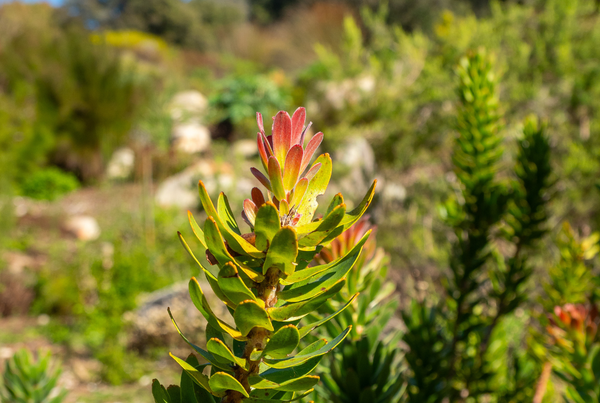
It is the oldest National Botanical Garden in South Africa, and the first botanical garden in the world to be dedicated to indigenous flora.
More Than Plants and Pathways
Kirstenbosch caters to all levels of nature lovers, and the facilities on site make it easy to spend many happy hours here.
At the Visitors Centre located at the bottom entrance (Gate 1), there is a ticket office, restrooms, a Vida e Café for coffee and snacks, and an information desk.
It is also where you will see some creative sculptures and find the inspiring Kirstenbosch Gift Shop. The range has a distinct botanical theme and includes bath and body products, homewares, African crafts and souvenirs, children’s gifts, clothing, accessories and artisanal sweets. Proudly local, over 85% of items are sourced from South African designers, artists and craftsmen.
For a lazy lunch, get a table at MOYO Kirstenbosch, situated close to Gate 1 inside the garden.
At Gate 2 is the wonderful Fynkos Kirstenbosch Tea Room, with indoor and outdoor seating, and close by is an art gallery that features local artists.
Happy By Nature is an indigenous retail nursery at Gate 2 with a wonderful shop and botanical studio that offers locally made indigenous botanical products, including herbal teas, essential oils, body care, and botanical-themed gifts and kids’ products.
The Best Three Ways to Explore the Garden
1. Roam Free and Do Your Own Thing
Enter the garden and follow whatever path takes your fancy. Look for shady spots, avoid hills, find streams or head for the hiking trails. Stop for lunch, bring a picnic, head straight for the Tree Top Canopy Walk (Boomslang) or search for the sculptures, and find the dinosaurs.
Read all the information boards and signs, or none of them, and just enjoy the views and tranquility of this green space.
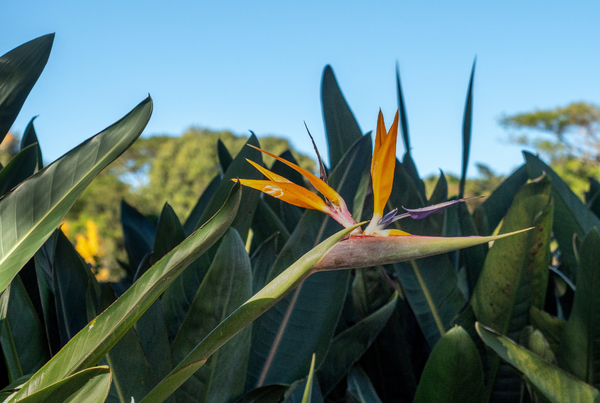
If you suddenly have a hunger for information, you can download the VoiceMap App and, for a nominal fee, purchase the GPS-triggered Kirstenbosch Audio Tour.
2. Join a Free Guided Tour
From Monday to Friday, at 10h00 and 11h00, visitors can join a free guided tour run by volunteers. Each tour can accommodate 15 people and is on a first come first served basis, departing from the Visitors Centre at Gate 1. The tours cover a brief history of the garden, and the guides are very clued up on the various plant species and are able to answer most questions you might have.
3. Book a Bespoke Bio-Cultural Tour with a Private Guide
Rupert Koopman is a freelance botanist/tour guide working in the fynbos region of the Cape. He has been described as a fynbos ninja and a modern day Sir David Attenborough, promoting South Africa’s nature and biodiversity.
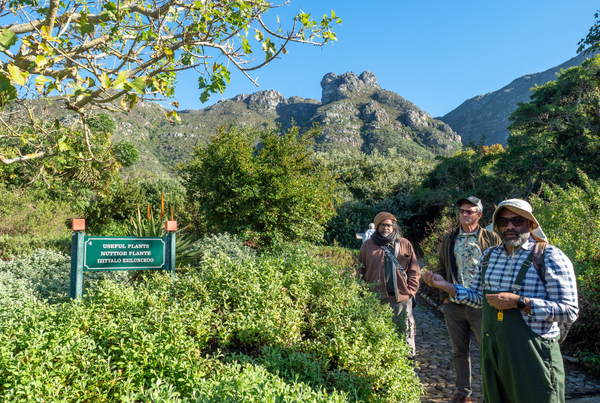
As a natural storyteller, for Rupert every plant is connected to a much bigger picture, and guided by him, Kirstenbosch became so much more than a botanical garden.
As the naturalist and conservationist John Muir famously said, “When one tugs at a single thing in nature, he finds it attached to the rest of the world.”
Rupert led us back to the ice age and Gondwanaland, relating how layers of ice affect soil structure and seeds, how trees become fossilised, and why dinosaurs and Cycads once thrived together.
He described how our Mediterranean climate allows our unique fynbos to thrive, why we need fire to activate certain seeds and how some plants have unusual pollinators like gerbils, the striped mouse, certain moths and the aptly named Table Mountain Beauty Butterfly.
Sitting on the massive boughs and roots of an ancient Wild Almond tree, we drifted into colonisation politics and recent history as Rupert told us about the infamous Van Riebeeck’s Hedge. Planted in 1660, Jan van Riebeeck used a wild almond hedge to mark the boundary of the Dutch settlement, and probably to keep the indigenous people out. Parts of this hedge are still alive in the garden today.
Fast forward to 1895, and another coloniser, Cecil John Rhodes, bought the land. Some say he redeemed himself when he bequeathed it to the government upon his death in 1902.
All this talk of conflict reminded Rupert of even older battles in the late 1400’s when various indigenous tribes with opposing lifestyles roamed these mountain slopes, and Portuguese navigators heading to India to buy spices aimed for, or got blown to, various natural bays along the Western Cape coastline to get fresh water.
One such explorer was an unpopular Portuguese Admiral, feared and loathed by his crew. During a vicious fight with the local people, his crew declared mutiny which resulted in something of a free for all bloodbath for both sides, but with the local people ultimately declaring victory.
We spent time at the Useful Plants section, where we crushed and sniffed various plants. This led to a culture and history lesson in the medicinal properties of many plants and how that knowledge has been passed down over thousands of years by the indigenous people, but never written down until recently.
Rupert explained how traditional healers use plants as part of a medical cure, in conjunction with other treatments that can include spiritual counselling, dietary guidelines, massage and hands on therapies and the use of natural minerals.
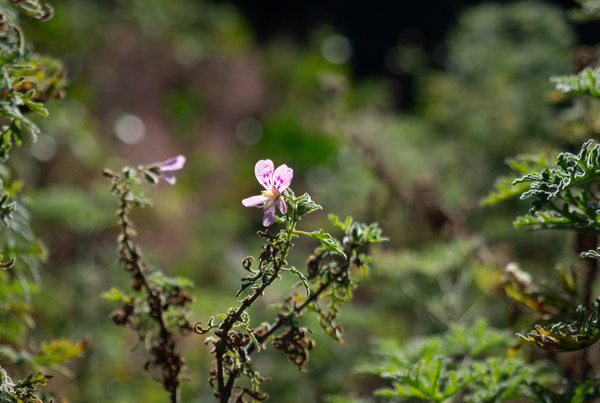
Heading towards the cool paths and streams of The Dell, we smelled the fragrant Pelargoniums, used for making teas, infused into chocolate and used as a base for perfume.
Birds abound, and shortly after telling us to look out for the resident Spotted Eagle Owl in The Dell, we saw it, well camouflaged and half asleep in a tree.
Wood’s Cycad, the Last of its Kind
“Sex is important” say Rupert with a grin as we walk along the path to the cycads.
This Wood’s cycad has been at Kirstenbosch for 110 years and has quite a story to tell. It is caged for its own protection as it is extinct in the wild.

In 1895, John Medley Wood found this clump of four cycad trunks in the Ngoye Forest in KwaZulu-Natal. Despite further extensive searching, no other living cycads were found here.
This was problematic as cycads require a male and female plant to reproduce, and the four trunks found by Wood were all male. It is believed that these cycads died out in nature due to excessive harvesting of the bark and other parts for use in traditional medicine and some cultural rituals.
Fortunately, the basal suckers can be cut off, cultivated and will be genetically identical to the original plant. So, the male of this species is the only survivor. Due to the rarity of this genus of plants, all cycads at Kirstenbosch are protected by motion sensors, microchips and other security measures.
Anyone with a curious mind and a love of stories will thoroughly enjoy this bio-cultural tour.
Earth Friendly and Water Wise
Near the top of the Garden is a 110 megalitre dam, fed by the many streams that flow down the mountain. This dam is the primary source of irrigation.
The drinking water at Kirstenbosch is delicious, as it is sourced via boreholes that tap into the Table Mountain Aquifer. It is stored in reservoirs and sanitised using ozone. Do yourself a favour and drink from any fast flowing stream, or from the many water fountains in the garden.
We drank water from the stream at Colonel Bird’s Bath and lived to tell the tale.
Operating Hours
Daily from 08h00 to 19h00 during summer (Sep-Mar)
Daily from 08h00 to 18h00 during winter (Apr-Aug)
Universal Access
All visitor entrance gates, restaurants, shops and venues are accessible for wheelchairs.

Kirstenbosch is set on a very steep gradient. Wheelchair friendly areas of the Garden include the area between the Visitors’ Centre (Gate 1) and the Centre for Home Gardening (Gate 2), the area surrounding the Main Lawn, the Conservatory, parts of the Dell, Useful Plants, Fragrance Garden, Peninsula Garden, Water-wise Garden and the Sculpture Garden.
Visitors in wheelchairs will need assistance when they visit the steep upper slopes, such as the Tree Canopy Walkway, Fynbos Walk, Protea Garden, Erica Garden, Van Riebeeck’s Hedge, Camphor Avenue and the concert area.
Please note that the Mathews Rockery, Cycad Amphitheatre, Arboretum and Pelargonium Koppie have step, rock or mulch paths and very steep gradients and are not accessible to wheelchairs.
Kirstenbosch is far more than a botanical garden. It is a place where nature, history, culture and conservation come together in a way few attractions can offer. As one of the Cape Town Big 6, it stands proudly alongside the city’s most celebrated experiences, offering visitors a chance to reconnect with nature and appreciate the remarkable biodiversity that makes Cape Town so extraordinary.
About the Author
Di Brown is a Cape Town–based freelance travel writer with over 20 years of experience in the tourism industry. Passionate about responsible travel, she is a strong advocate for ethical, sustainable tourism and animal welfare. When she’s not writing, Di can often be found capturing the beauty of her surroundings through her lens as a keen photographer.
Share your top Cape Town Big 6 moments with us!
Connect with us via our Cape Town Big 6 Facebook or Twitter page. Better yet, tag us on Instagram of your favourite outdoor moment and tag @CapeTownBig6 #CapeTownBig6
ONE DESTINATION, SIX UNFORGETTABLE EXPERIENCES
There is no one way to explore all of the Cape Town Big 6, and much of what makes each of them so special is the variety of things to see and do at each. So if possible, take your time to explore each of the city’s most visited tourist attractions in as much depth as possible – as any local will tell you, you can spend a lifetime at each of the Big 6 and still not tire of them. Find the 3 and 4 day itineraries and tips here.